Design systems are now consumed by humans and machines that assemble UI from tokens, components, and rules.
Teams and AI now produce interfaces faster than documentation can govern them.
As implementation accelerates, the distance between documented intent and shipped reality quietly grows.
Documentation cannot verify implementation.
Storybooks, token libraries, and documentation define the standard.
They cannot verify that production remains faithful to it.
Every undocumented override becomes hidden product debt.
Design systems need operational verification.
Verification changes the role of the design system.
It stops being documentation and becomes operational infrastructure.
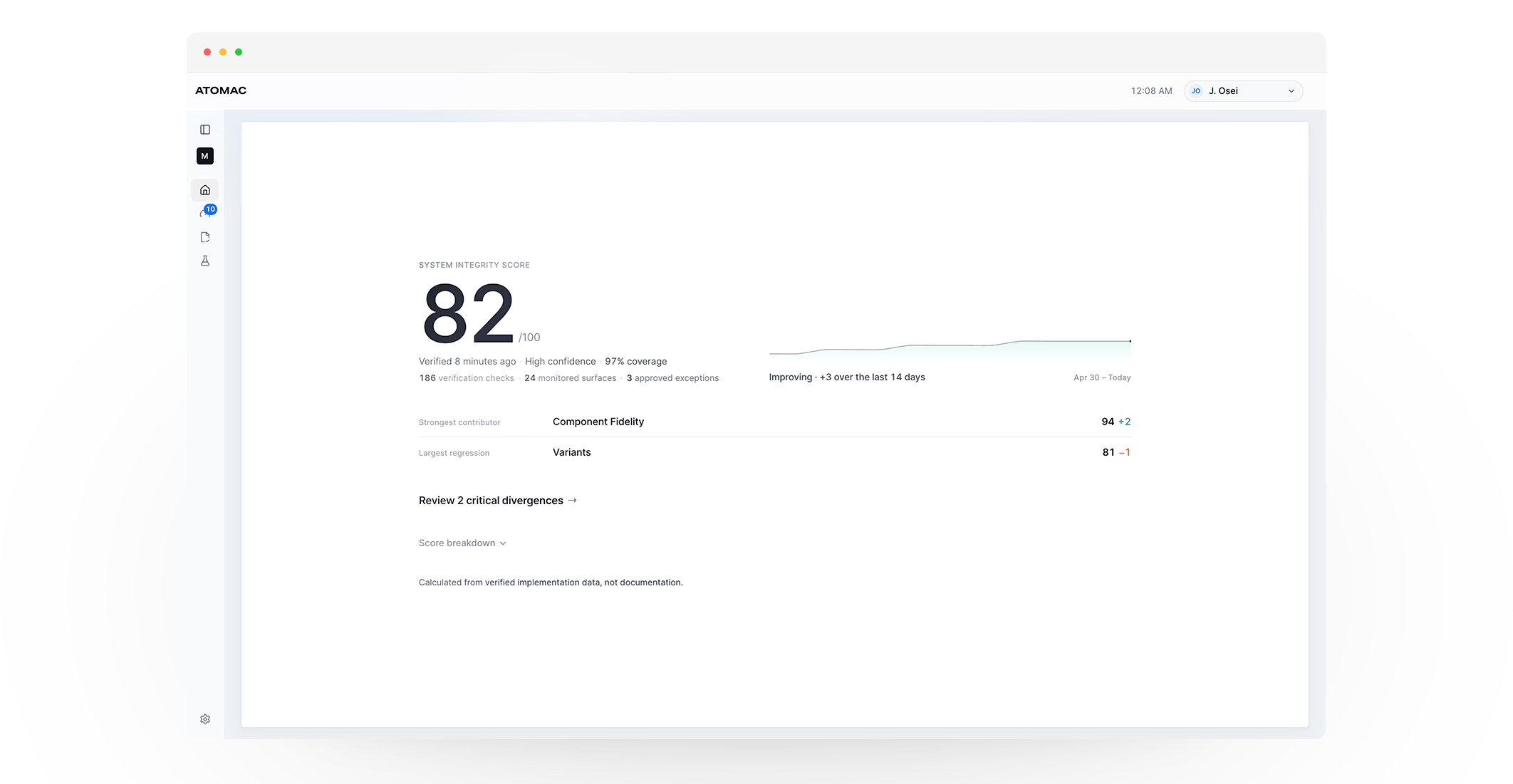
Atomac continuously measures the distance between canonical intent and shipped reality.
It surfaces meaningful divergence, routes ownership, and supports remediation or approved exceptions—preserving a decision history. Humans remain authoritative.
System Integrity™
Know when your product remains faithful to the system that defines it.
Verified Ownership
Every meaningful divergence has a clear owner and an accountable decision.
Explainable Decisions
Every remediation, exception, and review is recorded, attributable, and traceable.
Like frontend observability, but for interface consistency instead of runtime performance.
Atomac measures interface fidelity—revealing whether every shipped interface remains aligned with the design system that governs it.
Build with confidence.
Know the real health of your design system before inconsistency reaches production.
Atomac is in active development. I’m working with Design Systems, DesignOps, and frontend platform teams to define how interface observability should work in the AI era.
If you’re responsible for a design system at scale, I’d value thirty minutes to understand how you verify conformance today—and where documentation stops being enough.
Intent is documented.
Reality is verified.
Confidence comes from measuring the distance between them.